Ask most shoppers which is better — Black Friday or Cyber Monday — and you'll get a shrug. They assume the two events are interchangeable, two names for the same post-Thanksgiving sale. That assumption costs them money.
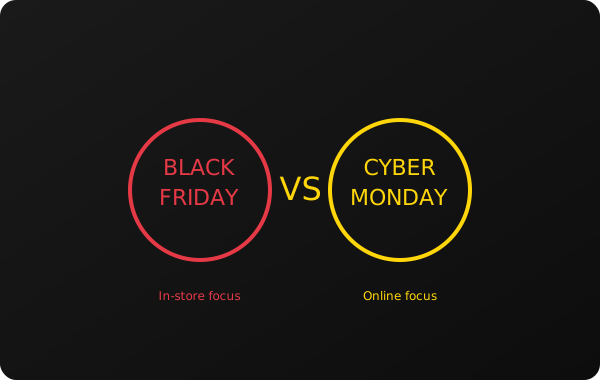
Black Friday and Cyber Monday are different events with different deal structures, different product focuses, and different optimal strategies. Understanding the distinction is one of the easiest ways to increase your savings during the holiday shopping season.
The Origins: Why They're Different
Black Friday began as an in-store event. Retailers used aggressive doorbuster pricing to drive foot traffic into physical locations, and the deals reflected that — large items, limited quantities, and prices designed to create lines around the building. Cyber Monday was created later as the online equivalent, targeting shoppers who were back at work after the holiday weekend but still in a buying mood.
Today the lines have blurred. Black Friday has a massive online component, and Cyber Monday deals appear in physical stores. But the underlying deal structures still follow the original pattern — and that pattern is predictable enough to exploit.
Category Comparison: Who Wins What
| Category | Black Friday | Cyber Monday | Winner |
|---|---|---|---|
| Televisions (doorbuster) | Deepest discounts, limited stock | Remaining inventory, online-only | Black Friday |
| Televisions (standard models) | Strong discounts | Often better — online retailers compete | Cyber Monday |
| Laptops | Good, especially in-store | Often better for online configs | Tie / Cyber Monday |
| Small appliances | Peak discounts | Deals continue but less selection | Black Friday |
| Large appliances | Best deals | Limited offerings | Black Friday |
| Tech accessories | Some discounts | Peak discounts | Cyber Monday |
| Software & subscriptions | Limited | Best deals of the year | Cyber Monday |
| Cameras & drones | Some deals | Better selection and pricing | Cyber Monday |
| Clothing & fashion | Strong retailer promotions | Online-only fashion retailers compete | Tie |
| Toys | Good deals begin | Continued but not peak | Black Friday |
Where Black Friday Wins
Doorbuster TVs and Large Electronics
If you want the absolute lowest price on a TV — and you're willing to navigate the doorbuster model landscape — Black Friday is your window. The in-store doorbusters offer prices that Cyber Monday doesn't match, because the entire point is to drive physical foot traffic. This is the one category where the original Black Friday model still fully applies.
Large Appliances
Refrigerators, washers, dryers, and ranges see their best Black Friday deals at home improvement retailers like Home Depot and Lowe's. These are items that require delivery and installation, making them naturally better suited to in-store sales. Cyber Monday appliance deals exist but are usually less aggressive. Our appliance deals guide covers this in depth.
Small Kitchen Appliances
The Instant Pot, air fryer, and blender deals that define Black Friday marketing are genuine. These are high-volume, low-margin items that retailers use to fill carts, and the discounts on Black Friday itself are typically the year's best.
Where Cyber Monday Wins
Standard-Model TVs (Online Only)
Here's the counterintuitive finding: while doorbuster TVs are cheaper on Black Friday, standard full-spec TVs are often cheaper on Cyber Monday. Online retailers — including Amazon, B&H, and Adorama — compete aggressively on Cyber Monday for the customers who missed the in-store doorbusters. If you want a real TV (not a doorbuster), wait.
Tech Accessories and Peripherals
Cables, chargers, mice, keyboards, monitors, and external storage see their best discounts on Cyber Monday. These are high-margin items that online retailers can discount deeply without hurting their bottom line. If you need accessories for the laptop you bought on Black Friday, Cyber Monday is your play.
Software and Subscriptions
This is Cyber Monday's secret weapon. Antivirus software, productivity suites, VPN subscriptions, and streaming service deals all peak on Cyber Monday. Many software companies only run major promotions twice a year — Cyber Monday and back-to-school season.
If you're buying a laptop on Black Friday, wait until Cyber Monday to purchase accessories, software, and extended warranties. You'll often save 30-50% on those add-ons.
Cameras, Drones, and Audio
Specialty electronics that don't make good doorbusters — cameras, drones, premium audio equipment — tend to see better deals on Cyber Monday. These products appeal to narrower audiences and are better suited to online retail's longer-tail sales model.
The Strategy: Using Both Days
The best approach isn't choosing one day over the other — it's using both strategically. Here's the framework we recommend:
- Black Friday: Buy doorbuster TVs (if you understand the model tradeoffs), large appliances, small kitchen appliances, and toys.
- Cyber Monday: Buy standard-model TVs, tech accessories, software subscriptions, cameras, and any items you missed on Black Friday.
For the complete week-by-week breakdown of when everything goes on sale, see our Black Friday timeline guide — it maps the entire shopping season from October through December.
What About Amazon?
Amazon doesn't really distinguish between Black Friday and Cyber Monday — their "Black Friday" sale typically runs for over a week, with new deals dropping daily. If you're an Amazon shopper, the distinction matters less. But even on Amazon, we've observed that certain categories (accessories, software) see better deals on the actual Cyber Monday date, while TVs and appliances see better deals earlier in the week.
For a broader comparison that includes Amazon's other major event, see our Prime Day vs Black Friday analysis.
"The shoppers who save the most don't pick a side. They use Black Friday for what it's best at and Cyber Monday for what it's best at — and they skip the rest."
Common Mistakes to Avoid
- Buying everything on one day. If you load up on Black Friday and ignore Cyber Monday, you'll overpay on accessories and software. If you wait for Cyber Monday for everything, you'll miss the doorbuster TV deals.
- Assuming Cyber Monday is just "leftovers." This was once true but no longer is. Many Cyber Monday deals are specifically created for the event, not clearance from Black Friday.
- Forgetting to verify deals. The same fake-deal tactics that appear on Black Friday appear on Cyber Monday. Run through our deal verification checklist for both events.
Conclusion
Black Friday and Cyber Monday are two different tools. Black Friday is your doorbuster play — TVs, large appliances, and kitchen gear at aggressive, traffic-driving prices. Cyber Monday is your online specialist — accessories, software, cameras, and standard-model electronics at competitive online pricing. Use both, use them for the right things, and you'll outperform shoppers who treat the holiday weekend as a single undifferentiated sale.