
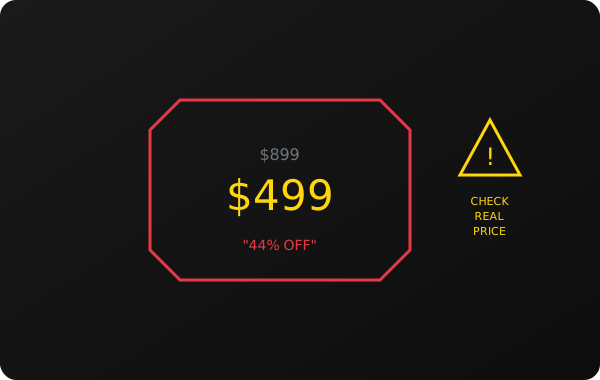
Here's a number that should change how you shop on Black Friday: a significant percentage of "Black Friday deals" aren't actually deals at all. They're the same price the product has been for months, dressed up with a red strikethrough and a percentage sign.
This isn't a conspiracy theory — it's a documented retail practice. Products are listed at an inflated "original price" for weeks before Black Friday, then "discounted" back to a price that's identical to (or slightly above) what the product sold for all summer. The discount looks impressive. The savings are zero.
This guide is your defense. It's a practical, step-by-step checklist you can run on any Black Friday deal before you click "buy." If an advertised deal doesn't pass these checks, walk away.
The Checklist
1. Check the Price History
This is the single most important step. Before considering any deal, look up the product's price history using a tracking tool. CamelCamelCamel (for Amazon), Honey, and Keepa all show historical pricing graphs going back months or years.
What you're looking for:
- Was the "original price" real? If the product sold at a lower price for months and was suddenly marked up in October, the "discount" is fake.
- Is this actually the lowest price? Sometimes the Black Friday price matches a previous low — meaning you're not saving anything by waiting.
- Has the product been cheaper before? If the price was lower during a previous Prime Day or summer sale, the Black Friday "deal" may underperform.
If the price history shows a sharp spike in October followed by a "discount" in November, you're looking at markup theatre. The product was never actually sold at the "original" price.
2. Verify the Model Number
As we cover in our TV buying guide, many Black Friday deals are on models manufactured specifically for the event. These doorbuster models look similar to standard products but have reduced specifications. Search the exact model number on the manufacturer's website — if it doesn't exist in their regular product lineup, it's a doorbuster variant.
Check for differences in:
- Processor generation (previous-gen chips in current-gen packaging)
- Memory and storage configurations
- Warranty length (reduced from standard)
- Port selection and connectivity options
3. Compare the Specs, Not the Names
Two products with similar names can have very different capabilities. A "4K Smart TV" could mean HDR10, Dolby Vision, or neither. A "gaming laptop" could have a current-gen or previous-gen GPU. Before comparing prices, make sure you're comparing the same product.
- Match the exact model number across retailers
- Compare storage capacity, RAM, and processor specs
- Check for feature differences (HDR format, refresh rate, port types)
- Verify the warranty terms match
4. Check Multiple Retailers
A "Black Friday exclusive" at one retailer is often available at the same price — or cheaper — at another. Retailers price-match during Black Friday, and online marketplaces frequently undercut brick-and-mortar stores. Before buying, check at least three retailers for the same model number.
| Check | What to Look For |
|---|---|
| Amazon | Often matches or beats retail Black Friday pricing |
| Manufacturer direct | Dell, HP, Lenovo, Samsung — sometimes offer deeper direct discounts |
| Competitor retailers | Price-matching is common; some beat advertised prices |
| Warehouse clubs | Costco and Sam's Club often have different (sometimes better) bundle pricing |
5. Calculate the Real Discount Percentage
Retailers calculate discount percentages creatively. A "50% off" deal might be calculated against the MSRP (which nobody actually pays), not the recent selling price. Calculate the discount yourself:
Real discount = (Recent average price − Sale price) / Recent average price × 100
If the real discount is under 15%, it's not a Black Friday deal — it's a normal price fluctuation.
6. Watch for Bundle Manipulation
Some Black Friday "deals" bundle a product with accessories you don't need to inflate the "total value." A laptop bundled with a cheap mouse, sleeve, and USB hub might be advertised as "$899 value for $599" — but if the laptop alone sells for $549 elsewhere, you're overpaying for accessories you didn't want.
Always check: what does the core product cost alone, without the bundle?
7. Check the Return Policy
Some retailers shorten their return windows for Black Friday purchases. A standard 90-day return policy might become 14 days for Black Friday items. Always check the return terms before buying — a "deal" with a non-returnable policy is a gamble, not a bargain.
Quick-Reference: Deal Red Flags
- The "original price" was set in the last 30 days (check price history)
- The model number doesn't appear on the manufacturer's website
- The discount is advertised as a percentage but no current price is shown
- The deal requires a bundle with accessories you don't want
- The return window is shorter than the retailer's standard policy
- The warranty is reduced compared to the standard model
- The deal is "lightning" or "doorbuster" with extremely limited stock — and no rain checks
Tools We Recommend
You don't need to do this manually. These tools automate much of the verification process:
- CamelCamelCamel / Keepa: Amazon price history tracking
- Honey: Price history across multiple retailers
- Google Shopping: Cross-retailer price comparison
- RTINGS.com: Product spec verification and professional reviews
When to Walk Away
If a deal fails two or more items on this checklist, skip it. There will be other deals — during Cyber Monday, during December clearance, and throughout the following year. As we explain in our Black Friday myth guide, not every category needs to be bought during this specific window.
The most expensive thing you can do on Black Friday is buy something because the ad made it feel urgent. Use this checklist, take five minutes per deal, and you'll avoid the majority of fake discounts that flood the market every November.
"A deal that can't survive five minutes of verification isn't a deal. It's a marketing exercise."
Next Steps
Once you can spot fake deals, the next step is knowing when to buy. Our complete Black Friday timeline maps when each category hits its real lowest price, and our year-round sale calendar shows opportunities beyond November. Combined with this checklist, you'll have a complete framework for evaluating any deal, any time of year.